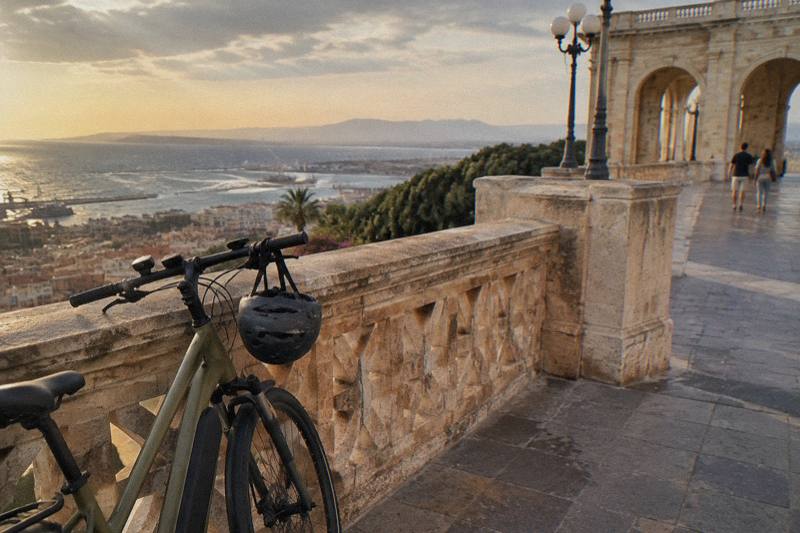
Is There A Hop-On Hop-Off Bus In Cagliari?
No classic multi-stop hop-on hop-off bus runs in Cagliari, though a seasonal open-top City Tour bus does, one loop from Piazza Yenne. To set your own pace: guided e-bike tours, city buses, trains and bike sharing, with prices and timings.
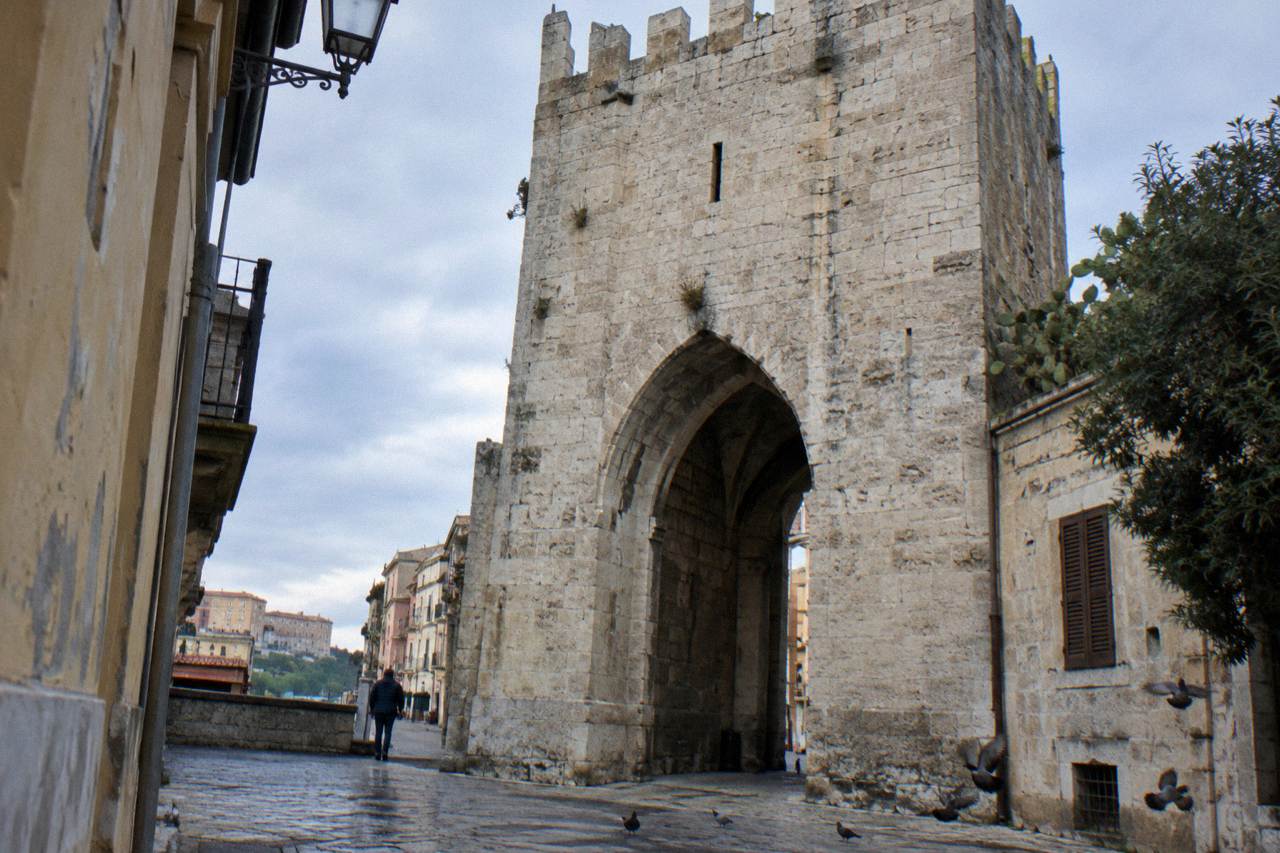
Cagliari does have an open-top bus, just not the year-round hop-on hop-off kind you may know from Rome or Barcelona. A seasonal City Tour Open Bus runs from 1 April to 31 October 2026, a loop of roughly one hour to one and a quarter hours from Piazza Yenne past Castello, the Gulf of Angels, Poetto and Molentargius, with an audio guide. It is a single circuit, not a ticket of stops you can board and leave at will. The city itself is compact but hill-steep, and a lagoon full of flamingos sits just beyond the edge of town. This page sets out what genuinely exists, what each option costs, and how a bike or e-bike can match the sightseeing-bus experience in a city built this way. Since those hills punish walking more than any bus schedule ever could, our plain-English guide to renting an electric bike in Cagliari covers where to rent, what you will pay, and when a guided tour makes more sense than going solo.
No, Cagliari has no classic multi-stop hop-on hop-off bus, but it does have something close: a seasonal open-top City Tour Open Bus that runs from 1 April to 31 October 2026. The city tour bus makes a single circuit of roughly 1 to 1.25 hours, departing from Piazza Yenne and passing Castello, the Gulf of Angels, Poetto and Molentargius, with an audio guide on board. It is one loop rather than a ticket that lets you jump off at each stop and reboard later, which is the key difference from the hop-on hop-off model found in bigger capitals. The city's tourism body leans on guided walks, e-bike tours and boat trips rather than a circuit bus with multiple boarding points, and that is largely geography at work. The sights people come for cluster in four old districts stacked on a hill, connected by lanes and stairways a large bus cannot use. For covering that ground, an e-bike fits the city better than any open-top double decker: the Old Town Guided E-Bike Tour from Viva Cagliari Tour covers Stampace, Castello, Villanova and Marina in 2 hours. Anyone wanting to confirm bus schedules for a specific day can ask at the tourist information point in Piazza Matteotti, since seasonal services can shift their timetables around peak cruise calls.
The gap matters most for two groups: cruise passengers with five or six hours ashore, and visitors staying outside the centre who want a loop that drops them near the cathedral, the Bastione di Saint Remy and the Roman amphitheatre. Cagliari does run a seasonal open-top City Tour bus, but it is one circuit with audio guide, not a classic multi-stop hop-on hop-off, so you cannot break the loop at will. The old town is small enough that a guided e-bike ride covers all four historic districts, Stampace, Castello, Villanova and Marina, in about two hours with a coffee stop built in, closer to what a hop-on hop-off ticket promises in a full day elsewhere.
There is also a free, tip-based layer to the city's sightseeing scene. Independent guides run free walking tours, meeting at the Bastion of Saint Remy, that cover the core on foot. Our page on free things to do in Cagliari lists them alongside viewpoints and beaches that cost nothing. Between a walk and a ride, most visitors find the bus question answers itself.
If the appeal of the hop-on hop-off formula was sitting back while someone else handled the route, the closest equivalent in comfort terms is a guided e-bike tour: the motor flattens Cagliari's hills, the guide handles navigation, and you still stop where it counts. The port's growing traffic makes planning this layer worth a few minutes too. The 2026 cruise season projects 181 port calls and more than 600,000 passengers, a 26 percent increase over 2025, and a single late-October day in 2026 brought four ships and more than 11,000 passengers into the harbour at once. On days like that, a small-group ride with a capped headcount beats queuing for a bus that does not exist.
What Replaces The Sightseeing Bus In Cagliari?
Guided e-bike tours work best for seeing Cagliari without a classic multi-stop hop-on hop-off bus, and that classic format is what the city lacks. A seasonal open-top City Tour Open Bus does run from April to October, covering Piazza Yenne, Castello, the Gulf of Angels, Poetto and Molentargius in about an hour with an audio guide, but it is a single loop rather than a hop-on hop-off circuit. Beyond that bus, the CTM city network, municipal bike sharing and walking fill out the options. Guided e-bike rides from the centre cover the old town in around two hours and the Molentargius flamingo lagoon in two to four, with prices from $50 per person across the current options, nearly all of them including a guide, a bike and free cancellation. City buses handle the longer hops, above all the line out to Poetto beach, though without commentary or a tourist route. Bike sharing fills the gaps for short one-way trips, and the old town itself rewards walking because cars barely penetrate it.
The headline alternative, for most visitors, is the e-bike tour. The best reviewed option at the moment, the Old Town E-Bike With Coffee Stop, runs about two hours, is rated 4.9 across 369 reviews, costs from $53 per person and caps groups at 9 riders. It meets at Via Santa Margherita 22, a short walk from the cruise port, includes bike use, bottled water and a coffee or tea, and comes with free cancellation. The listing describes stops across the historic districts with a local guide, which delivers the circuit-bus promise of a fixed route with commentary, minus the traffic and the window glass.
The Old Town Guided E-Bike Ride covers similar ground at from $56 per person, rated 4.9 across 325 reviews, with a coffee or soft drink and bottled water included, and no hotel pickup. And for anyone whose mental image of a sightseeing circuit includes water and wildlife rather than churches, the Old Town and Flamingos Combo strings the historic centre together with the Molentargius canals in about two and a half hours, rated 4.7 across 126 reviews, from $56 per person, e-bike and helmet included. None of these involves a bus window, and all of them stop where a bus could not.
Comparing The Main Alternatives
| Option | What it covers | Time | Cost | Best for |
|---|---|---|---|---|
| Old Town E-Bike With Coffee Stop | Historic districts with a guide and coffee stop | ~2 hours | from $53 per person | Cruise passengers, first-time visitors |
| Old Town Guided E-Bike Ride | Four historic districts, drinks included | ~2 hours | from $56 per person | Review-backed classic circuit |
| Old Town and Flamingos Combo | Old town plus Molentargius canals | ~2.5 hours | from $56 per person | Wildlife and city in one outing |
| Poetto and Flamingos E-Bike Tour | Canals, lagoon and Poetto beach | ~4 hours | from $80 per person | Half-day exploration, groups max 8 |
| Bike Rental Delivered To You | Self-guided, city or mountain bike | ~7 hours | from $28 per person | Independent riders, no guide |
| Free tip-based walking tour | Old town core on foot | 1 hour 30 minutes | tip only | Budget travellers, slow sightseeing |
Ratings shown are from the booking pages of each tour, with review counts beside them, because a rating means little without the pool behind it. The delivered rental is a standard city or mountain bike, not electric; no option on this site rents an e-bike alone without a guide. If a detail such as helmet provision or group size is not stated on a listing, check the booking page rather than assuming, since inclusions genuinely vary from tour to tour.
Why A Bike Suits Cagliari Better Than A Bus Would
A bike fits Cagliari better than a bus because the city's street plan works against large vehicles: the historic core climbs a hill of narrow lanes, staircases, and limited-traffic zones built at a human scale, not a bus's. On two wheels you can follow those lanes and reach corners a bus simply cannot. Cagliari's ZTL rules restrict vehicle access across districts such as Castello, Marina, Stampace and Villanova, and the details vary by street and by hour, so it is worth checking the Comune di Cagliari ZTL page before you drive anything in. In plain terms: the machine a hop-on hop-off bus cannot bring into the old town is exactly the machine an e-bike is.
Italian law helps here too. A compliant pedal-assist bike, motor capped at 250 W with assistance cutting out progressively at 25 km/h, is legally a bicycle: no licence, no plate, no insurance, and access anywhere bikes are allowed. Riders must be at least 14 to ride one on public roads, and helmets are mandatory for under-18s while remaining strongly recommended for everyone else. Cagliari's hills, which punish a conventional bike ride up to Castello, are precisely what the assist flattens, which is why nearly every guided option in the city is electric rather than acoustic.
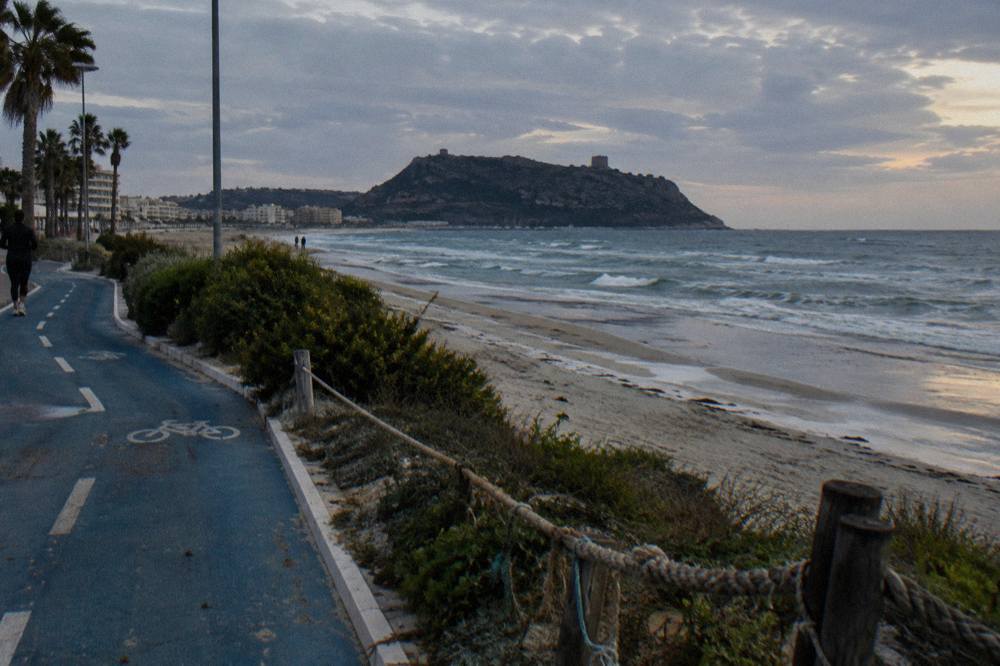
The city is also investing in the infrastructure a circuit bus would duplicate. The metropolitan Biciplan approved in February 2026 grows the cycle network from 243 km to 366 km across Cagliari and 17 neighbouring municipalities, and roughly 12 km of new or upgraded lanes are under construction on more than 30 streets, as reported by CagliariToday. The 8 km promenade along Poetto beach gives that network a flat, car-free spine from the Sella del Diavolo headland toward Quartu Sant'Elena, shared between walkers, runners and cyclists with some shared sections. A bus loop would fight this geography; a bike uses it.
Can You Use City Buses And Trains Instead?
Yes, you can. CTM city buses cover Cagliari's urban routes, including the run out to Poetto, and Trenitalia regional trains connect the city with the rest of Sardinia, though each operator sets its own defined rules for carrying bicycles, so confirm the details for the service you plan to ride. Buses replace the point-to-point function of a hop-on hop-off service, though without commentary or a tourist route, so they solve transport rather than sightseeing. On trains the bike terms are clear and cheap, a EUR 3.50 daily supplement on regional services, which makes rail a realistic way to bolt a coastal town onto a city visit. For bike-on-bus arrangements the operator's own terms govern, so check them before you plan a hybrid day.
Trenitalia regional services in Sardinia take one bicycle per traveller, e-bikes included, up to 2 m in length, for a EUR 3.50 daily supplement or the price of a second-class single for the same journey. The full conditions are on Trenitalia's official bike page. That opens up the coastal and inland towns around the city, and a dedicated guide to day trips from Cagliari by bike and train works through the combinations. ARST regional buses and trains apply their own bike ticketing, around EUR 3.50 for a 24-hour bike ticket on the services where bikes are carried, but terms vary by line, so confirm on the operator's tariff pages.
For the Poetto beach run, the bus is genuinely useful, and the promenade at the far end is flat, asphalt-surfaced cycling of the easiest kind. Our Poetto bike path guide covers the route, the beach facilities and the seasonal rhythm of the stabilimenti, whose lounger-and-umbrella sets typically run EUR 10 to 15 per day at the licensed operators along the sand. Most beach bars reduce their hours from roughly October to April, so the strip is quieter in the shoulder season.
A bus gets you there; it does not explain what you are passing. Nobody on the CTM run to Poetto points out the salt pans, and no driver waits while you photograph flamingos. The old town lanes, meanwhile, are a job for feet or two wheels. Treat the bus as the connector and give the sightseeing to a guided ride or a walk. Everything else on this site is indexed on Cagliari Bike Tours.
What About Bike Sharing And Free Walking Tours?
Yes, both options are alive and well in Cagliari: the municipal CaBuBi bike-sharing scheme puts 60 one-way bicycles at 10 stations around the city, and independent guides run free, tip-based walking tours of the old town, meaning the cheapest layers of sightseeing are fully covered even if you never set foot on a bus. CaBuBi's fleet is 50 classic bikes, 6 pedal-assist, 3 tandems and a single cargo bike, with 70 more free-flow bikes announced as coming, according to the city's official tourism site. It is a utility system, aimed at short hops, and the pedal-assist share is small, so it complements rather than replaces a guided tour for visitors who want commentary along with the wheels.
The free walking tours fill the commentary role. The primary walk, urban hiking at sunset, runs 1 hour and 30 minutes in English, rated 4.94 across 48 reviews, meeting at the Bastion of Saint Remy where the guide carries a sign. A second option aimed at cruise passengers runs from the port and back in about 1 hour and 45 minutes, in English and Italian. These are independent, tip-based walks on a separate free-tour platform, not products of this site, and they work best paired with something that covers ground: a ride out to the lagoon or the beach, which a walking route cannot reach in the time.
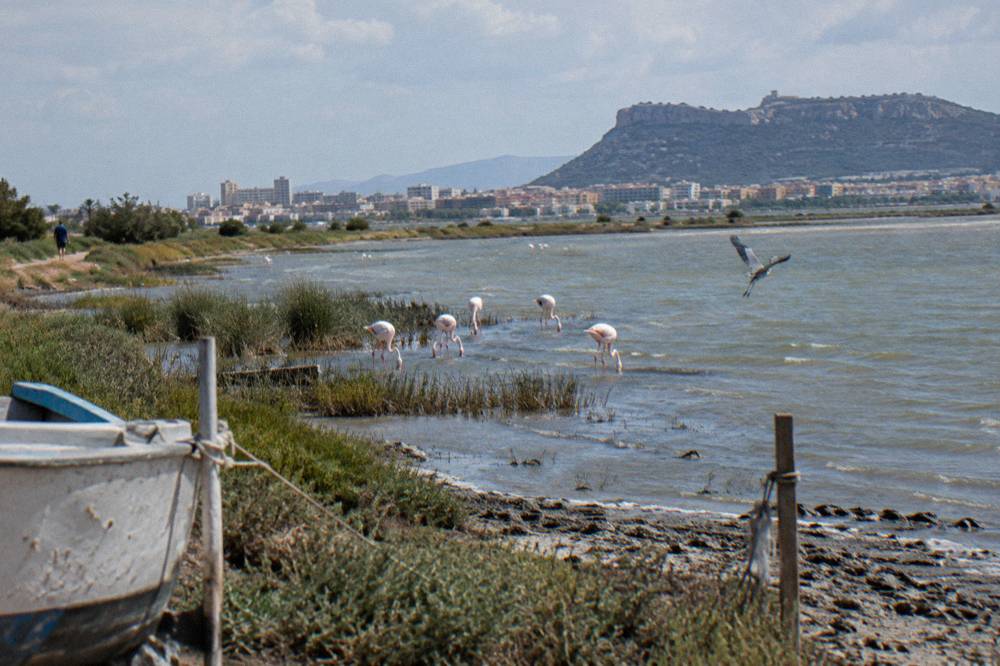
Flamingos are the reason the lagoon side of the city earns its place in any plan. The birds are present at Molentargius-Saline year round, with the colonies largest between April and September and the first weeks of June the most photogenic. The park's green areas are open 1 March to 15 October from 06:30 to 21:00, and 16 October to 28 February from 07:00 to 18:00, per the park's official site, and its own wording permits cycling only with non-motorised means on the designated paths, with riders staying on marked itineraries and yielding to pedestrians. Guided e-bike tours accordingly ride the surrounding canals, public paths and the Poetto side, and the tour listings mention flamingos without promising them, since wildlife does not take bookings.
Which Option Suits Your Trip Best?
Pick a guided e-bike tour if you want the circuit-bus experience with commentary built in; choose a delivered rental if you would rather have independence at the lowest price; and rely on buses or trains purely as connectors between the city and its surroundings when you simply need to get from one place to another. The decision mostly comes down to how much time you have in port or in town, and whether wildlife or architecture leads your list. The table of alternatives above gives the price anchors: guided rides run from $50 to $80 per person depending on length and route, while self-guided rental starts at $28 per person for a delivered city or mountain bike over roughly seven hours.
Cruise passengers are the group most often hunting for a hop-on hop-off bus, and Cagliari's port is busier than ever: the 2026 season projects 181 calls and more than 600,000 passengers, a 26 percent increase over 2025, and one late-October day saw four ships arrive together with more than 11,000 passengers between them. The two-hour old town rides fit a typical shore day comfortably, and the meeting point at Via Santa Margherita 22 sits near the port. The Two-Hour E-Bike Tour With Coffee, from $50 per person and rated 4.7 across 281 reviews, includes one coffee and the bike, with free cancellation; check the booking page for start times that match your ship's schedule.
Longer-stay visitors can afford the four-hour formats. The Poetto and Flamingos E-Bike Tour, from $80 per person, rated 4.8 across 85 reviews with groups capped at 8, links the lagoon canals to the beach promenade in one loop, with helmet, bike, guide and bottled water included. The more ambitious Bike and Hike to Devil's Saddle, from $78 per person, rides to Calamosca and then climbs the Sella del Diavolo promontory on foot, because bicycles are not allowed on its protected Natura 2000 trails; that constraint is a firm rule, not a suggestion, and the tour is built around it. Our page on Sella del Diavolo by bike and on foot explains the split in detail.
Season shapes the choice too. July and August average highs of 31.6 and 32 degrees Celsius with almost no rain, 3 mm and 10 mm respectively in a typical month, so morning departures and the assist motor earn their keep, and the maestrale wind can make exposed coastal stretches hard work in the afternoons between May and September. March to May and September to October bring milder highs of roughly 17 to 28 degrees and suit the longer itineraries. Whatever the month, book the ride, not the bus.
For travellers who like the structure of a circuit but not the schedule of one, there is a middle path worth naming: combine a short guided ride for the orientation, then keep a delivered rental or a shared bike for the rest of the stay. The guided hours tell you which lanes matter and where the viewpoints hide; the solo hours let you linger. It is the closest thing to a hop-on hop-off ticket that Cagliari's geography will ever permit, and in practice it works better than the bus would have, because every stop is one you chose.
Common Questions About Getting Around Cagliari
Is There A Hop-On Hop-Off Bus In Cagliari?
Cagliari has no classic multi-stop hop-on hop-off bus. It does have a seasonal open-top City Tour Open Bus, running April to October, one circuit of roughly an hour past Castello, the Gulf of Angels, Poetto and Molentargius with audio guide. For stopping where you like, guided e-bike tours of the old town start from $50 per person for about two hours.
What Is The Best Alternative To A Sightseeing Bus In Cagliari?
A guided e-bike tour. The best reviewed options cover the four historic districts in about two hours with a local guide and a coffee stop, from $53 per person, with groups capped at 9 on some departures and free cancellation available.
Can You Take A Bike On Cagliari Buses And Trains?
On Trenitalia regional trains, yes: one bike, e-bikes included up to 2 m, for a EUR 3.50 daily supplement. On CTM city buses the rules are restrictive and terms should be checked directly with the operator before you travel.
Is Cagliari Easy To Explore On Foot?
The historic core is very walkable, with the districts tightly packed on one hill, though the slopes are steep. Free tip-based walking tours lasting 1 hour and 30 minutes cover the main sights, meeting at the Bastion of Saint Remy.
Does Cagliari Have Bike Sharing?
Yes, the municipal CaBuBi scheme runs 60 one-way bikes across 10 stations: 50 classic, 6 pedal-assist, 3 tandems and 1 cargo bike, with expansion announced. It suits short hops rather than a full sightseeing circuit.
Can You See Flamingos Without A Boat Or A Bus?
Yes. Flamingos are present at the Molentargius-Saline lagoon year round, and guided e-bike tours ride the canals and public paths around it, with the park's own green areas reserved for non-motorised bikes on designated paths.