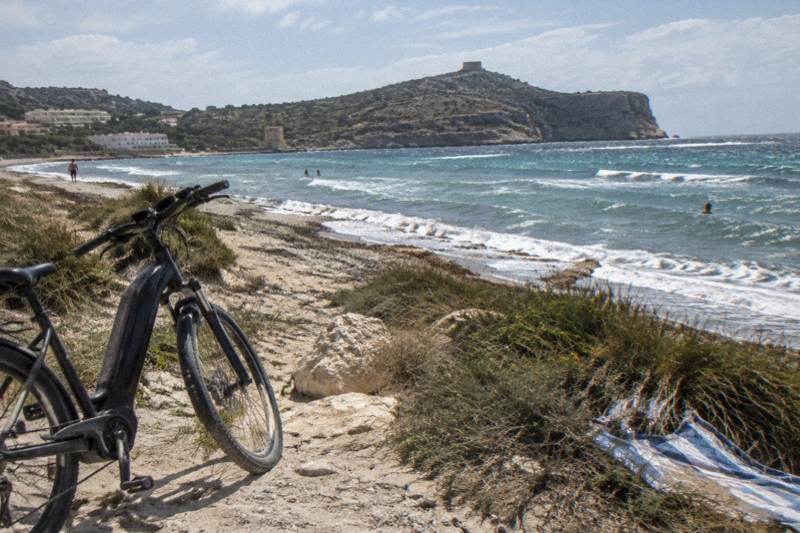
Is Poetto Beach Worth Visiting?
An honest look at Poetto Beach: the sand, the water, the flamingo lagoon next door, the costs and the best months to go, plus how a bike tour ties the coast together.
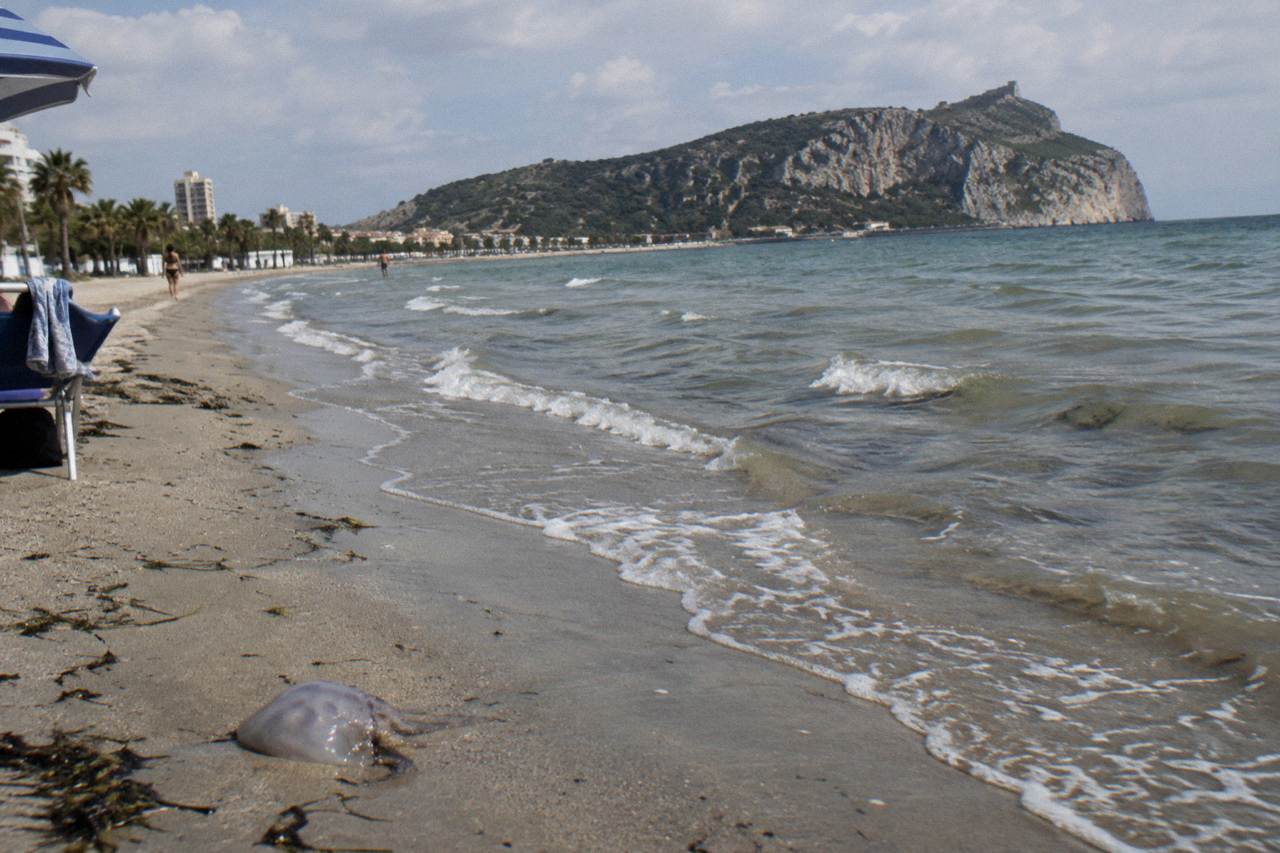
Yes, for most visitors Poetto is worth visiting, with one caveat about expectations. It is a genuine eight-kilometre city beach backed by beach clubs and a flat promenade, not a remote cove, and it sits directly beside a lagoon where flamingos live year round. If you want convenience, space, cheap sunbeds and an easy bike or bus ride from the centre, it earns its place on any Cagliari itinerary. If you're planning the rest of your time in the city, our guide to a full day in Cagliari shows how to fit the beach, the old town and the flamingo lagoon into a single trip.
That is the short verdict, and it holds across most of the year. Poetto is unusual among European city beaches for its sheer length: the strip of sand runs about eight kilometres from the Sella del Diavolo headland at the Marina Piccola end toward Quartu Sant'Elena, with numbered beach clubs, free stretches of sand and a mostly asphalt cycle and pedestrian promenade along almost the whole way. You do not need a car, a boat or a full day trip to reach it. A CTM bus from the centre takes roughly twenty minutes, and a bike takes a pleasant flat ride along the same corridor.
The caveat is that Poetto is urban and popular. The water is shallow and the seabed is sandy rather than rocky-turquoise, so travellers chasing the postcard coves of Chia or Villasimius sometimes find it plain. What Poetto offers instead is a working beach: locals swim before work, runners and cyclists use the promenade at all hours, and the whole thing is stitched to the city in a way few Mediterranean capitals can match. If your question is whether it competes with Sardinia's famous beaches, the honest answer is no. If your question is whether it is worth half a day of your Cagliari trip, the answer is comfortably yes.
The strongest argument for Poetto is what sits behind it. The Molentargius-Saline Regional Natural Park, a lagoon and former saltworks that is one of the closest year-round flamingo colonies to any European city, begins directly across the road at the western end. Very few beaches anywhere let you swim, then ride five minutes inland and watch flamingos feed. That combination, beach plus lagoon plus headland, is the reason this site exists, and a guided ride is the most efficient way to see all three in one morning. If you're still deciding which stretch of coast suits which kind of day, the guide to Poetto, Calamosca and Cala Fighera explains how to match each beach to your plans.
The Poetto and Flamingos E-Bike Tour is the fullest version of that idea: about four hours, from $80 per person, rated 4.8 across 85 reviews, with a local guide, bike, helmet and bottled water included and a group capped at eight. It starts at the Easycletta shop and ties the old town approach, the canal paths and the Poetto seafront into a single loop, which is exactly the shape of the coast that makes the beach worth the visit in the first place.
How Long Is Poetto Beach And What Is The Water Like?
Poetto runs about eight kilometres of sand from the Sella del Diavolo headland toward Quartu Sant'Elena, with shallow water and a sandy seabed that shelves gently. Swimmers can walk out a long way before losing their footing, which families love and snorkellers tolerate. The water is clean and calm on most days, but it is not the transparent turquoise of Sardinia's southern coves, and after strong wind it can cloud quickly.
The shallowness is the defining trait. At high summer the water warms early and stays warm into October, and children can play well out from shore in waist-deep water. For adults who like serious swimming, the far end toward Marina Piccola and the Sella del Diavolo end tends to be the more scenic stretch, with the white limestone promontory closing the view. The headland itself, a protected Natura 2000 site, forbids bicycles on its trails, so the classic pattern is to ride or walk to the Calamosca side and hike the top on foot. Local press reported in October 2026 that cyclists riding the promontory trails had drawn a formal complaint to the municipal police, which tells you how seriously the ban is taken.
Depth and clarity aside, the beach is divided into numbered sections, from the first beach clubs nearest the city down toward the Quartu end. The licensed stabilimenti rent sun loungers and umbrellas, typically around 10 to 15 euros per day for the pair, and most beach bars reduce their hours from roughly October to April. Between the clubs there are free stretches of public sand where you simply lay a towel. In peak August, when the city is at its hottest and fullest, the free sand fills fast by late morning; in the shoulder months you can have metres to yourself.
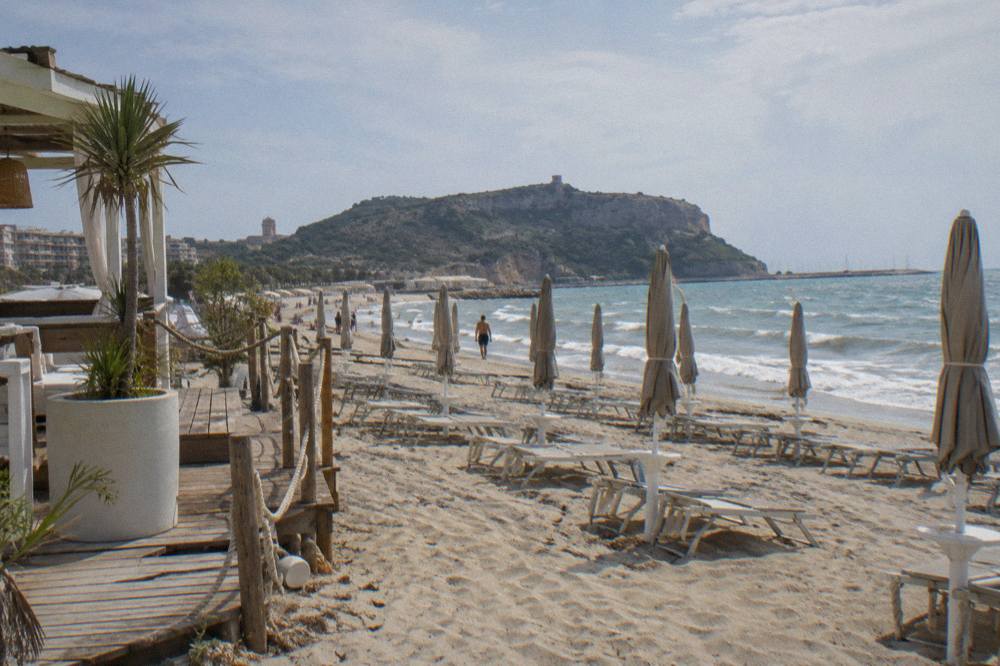
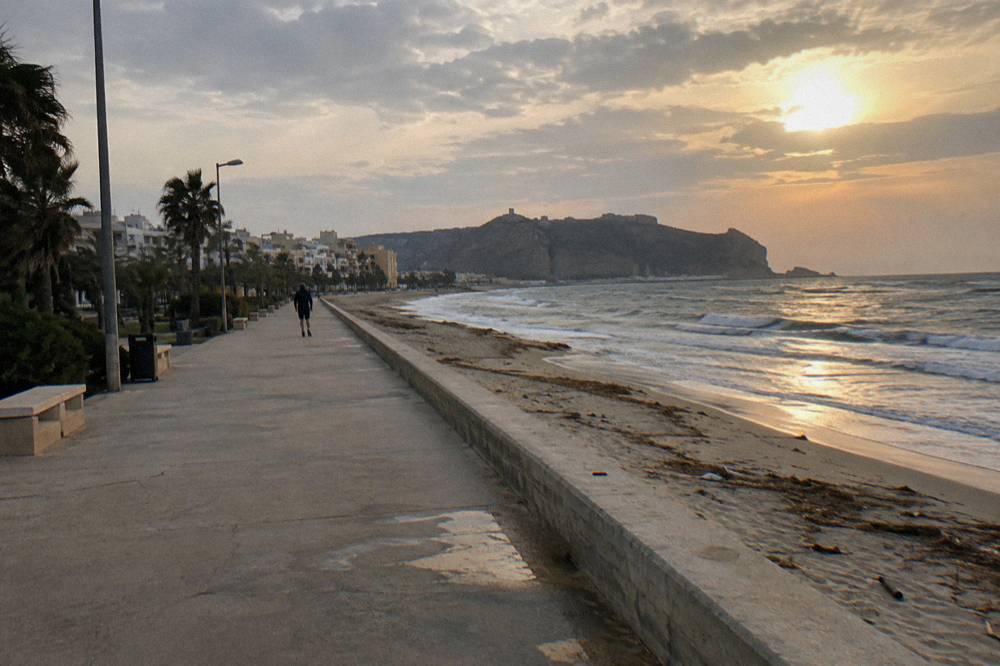
The promenade deserves its own mention because for many visitors it becomes the best part of the day. Locals walk, run and cycle almost the entire length, and the surface is mostly asphalt with some shared sections where pedestrians, runners and cyclists mix. That flatness is why Cagliari Bike Tours treats the Poetto corridor as the backbone of its coastal routes: whatever your fitness level, the riding here is easy, and the wind, more than any hill, is the only real resistance. For a deeper route-by-route breakdown, see the Poetto bike path guide.
Wondering whether a guided loop beats finding it alone? This is the ride that connects the beach to the lagoon behind it.
When Is The Best Time Of Year For Poetto?
The sweet spots are May, June, September and early October, when highs sit in the milder range, the water is warm and the crowds thin. July and August bring average highs of 31.6 to 32 degrees, minimal rain and the busiest sand of the year. Winter is mild and often beautiful, but swimming is for the hardy and many beach facilities operate reduced hours.
Cagliari's climate normals for 1991 to 2020 show July averaging a high of 31.6 degrees with just 3 mm of rain, and August a high of 32 degrees with 10 mm. That heat fades slowly. September and October sit in the milder shoulder band, with daytime highs between 17 and 28 degrees, so the beach season outlasts the tourist season by a wide margin. If your trip falls in October, Poetto is arguably at its best, with empty sand, soft light and the whole promenade to yourself.
| Months | Typical conditions | What to expect at Poetto |
|---|---|---|
| May to June | Warm, dry, building heat | Warm sea, thin crowds, flamingo nesting season peaks |
| July to August | Highs 31.6 to 32 C, 3 to 10 mm rain | Full beach, lively evenings, busiest beach clubs |
| September to mid-October | Warm sea, softer heat | The locals' favourite window, space returning |
| Late October to April | Mild, variable, some rain | Quiet sand, reduced beach bar hours, walking and cycling season |
One seasonal factor the postcard shots never mention is the maestrale, the northwest wind that dominates Cagliari's weather year round and blows hardest from May to September, with summer gusts that can exceed 50 km/h on exposed coast. On a strong maestrale day the sea at Poetto chops up and the sand moves. The flip side is practical: wind days are superb cycling days on the sheltered canal paths behind the beach, which is one reason the flamingo rides work all summer. Operators report conditions honestly, and every tour listed on this site offers free cancellation if the weather turns your booking into a bad idea.
The calendar matters in one other way. The Sant'Efisio procession on 1 to 4 May fills central streets like Stampace and Via Roma and can complicate central routes, though the beach itself is unaffected. And the cruise calendar is real: the 2026 season projects 181 port calls and over 600,000 passengers, so on quadruple-call days the sand nearest the city fills earlier than you might expect. A morning beach, afternoon old town pattern beats the reverse when several ships are in.
Can You See Flamingos From Poetto?
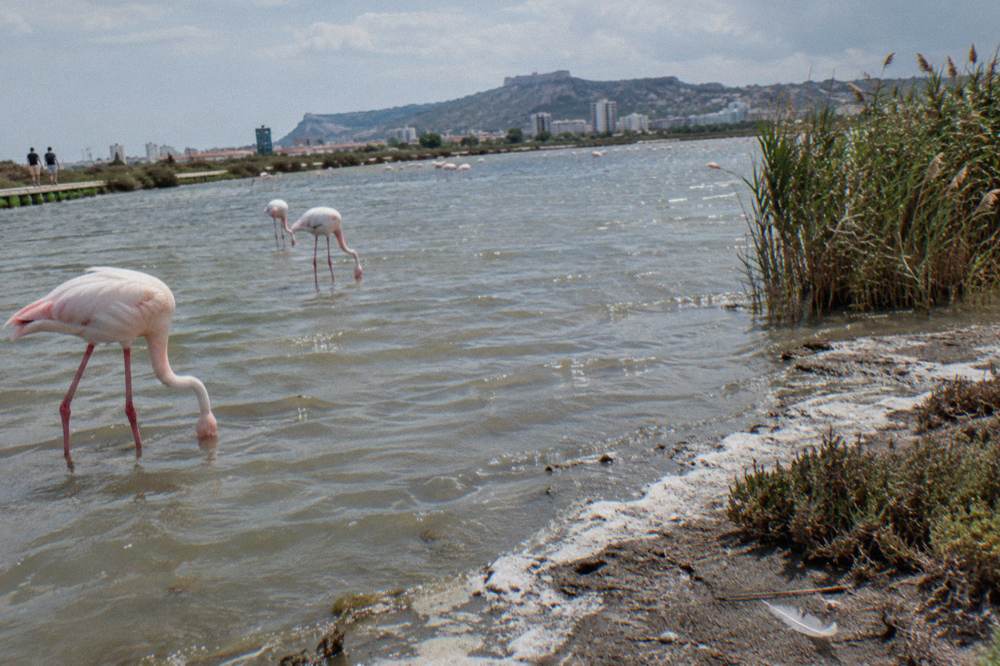
Yes, and this is the reason Poetto punches above its weight. Molentargius-Saline park, where greater flamingos live all twelve months of the year, begins directly behind the beach, and the cycle path along Via la Palma is a known viewing spot. The colony has nested steadily since 1993, with numbers and nesting peaking April to September and the first weeks of June the most active.
The detail that surprises first-time visitors is how close the birds are. The lagoon is not a distant reserve requiring a drive; it shares a boundary with the beach's western end, and from the right vantage points on the canal paths you can watch flamingos feed with the city skyline behind them. The park's own visitor page confirms the practical rules that matter to cyclists: the green areas are open daily, from 06:30 to 21:00 between 1 March and 15 October and from 07:00 to 18:00 from 16 October to 28 February, and cycling inside them is for your own non-motorised means on the marked itineraries, yielding to pedestrians. The park infopoint keeps its own hours too, 08:30 to 18:30 from October to March and 08:30 to 20:30 from April to September.
That last point deserves precision, because sloppy claims circulate. The park's own wording covers non-motorised bikes, so an e-bike is not covered for the managed green areas. Guided e-bike tours ride the surrounding canals, public paths and the Poetto side, which is where most flamingo viewing happens anyway. Two of the shorter options make that loop their whole focus. The Flamingo Oasis Bike Tour runs about two hours from $56 per person, rated 4.6 across 158 reviews, bike and helmet included, meeting at NewWaySardinia. If your day combines the beach with a quick lagoon loop, it is the least time-hungry way to do both.
Sightings are nature, not a schedule, and no honest operator will promise birds on a given morning. What the biology supports is reassuring: the population is settled year round near Cagliari, part of it resident through winter, so any month can produce views. Bring the small binoculars if you have them, keep to marked paths, and treat close approach by drone or off-path scrambling as the bad idea the park rules say it is. Pets are allowed in the park on a lead, with large dogs muzzled, which matters if your beach day includes a dog. For the full picture on the lagoon, its rules and its rides, the Molentargius flamingo bike tour guide goes deeper.
How Do You Get To Poetto From Cagliari Centre?
Three ways, all easy: the CTM bus, which takes about twenty minutes from the centre; a bike along the flat seafront corridor, which is the nicest option on a calm day; or an e-bike tour that strings the old town, canals and beach together. There is no need for a car, and parking in August is the one genuine headache driving creates.
The bus is the workhorse. CTM runs frequent services down the coast, and the ride from the centre is roughly twenty minutes, dropping you within a short walk of the sand. Cyclists should check CTM's current rules before planning a bus-and-bike combination, as the listing of what city buses accept is best confirmed directly. Regional trains are more generous: Trenitalia's regional services in Sardinia take one bicycle or e-bike per traveller, up to two metres in length, for a 3.50 euro daily supplement or the price of a second-class single ticket, useful if you are stringing Poetto into a wider rail-and-ride day.
Cycling there is where the city quietly shines. The corridor to Poetto is flat, the metropolitan Biciplan approved in February 2026 grew the area's cycle network to 366 km of routes, and around 12 km of new or upgraded lanes were under construction on more than thirty streets. Limited-traffic zone rules vary by street and by hour, so before riding into the historic districts it pays to check the Comune di Cagliari ZTL page for current restrictions. Guided e-bike tours of the old town handle this planning for you, and the ride from a medieval hill district down to the sand is a big part of their appeal. If you would rather not own a bike for the day at all, the CaBuBi municipal bike-sharing scheme puts 60 bicycles, 50 classic plus 6 pedal-assist plus 3 tandems and 1 cargo bike, across 10 one-way stations, with expansion announced.
If you would rather not navigate, the guided options solve it. The Old Town and Flamingos Combo squeezes the two highlights into about 2.5 hours from $56 per person, rated 4.7 across 126 reviews, with local guide, e-bike and helmet included, meeting at NewWaySardinia. It is the right shape for a morning with an afternoon flight, or for a day when the beach itself is the main event and the birds are the bonus.
For walkers, the honest answer on distance is that it is a long way on foot, and the question comes up often enough to deserve a full answer; see can you walk from Cagliari to Poetto beach for the details. The short version: possible, flat, not the best use of a hot afternoon. For families weighing the whole question of riding with children, the Cagliari bike tour with kids guide covers ages, seats and what actually works on this coast.
What Does A Poetto Day Cost?
The beach itself is free, and that is the headline. A lounger and umbrella at a licensed beach club runs about 10 to 15 euros per day, a coffee or a simple lunch at a beach bar is city pricing, and the bus costs a normal city fare. Add a guided ride and the day's budget becomes clear: flamingo and coast tours run from $56 to $80 per person depending on length, all with free cancellation.
Laid out side by side, the guided options that include the Poetto and lagoon corridor look like this. Prices are per person as shown on each booking page, and every one of them can be cancelled free of charge if plans change.
| Tour | Length | Price | Rating | Group cap |
|---|---|---|---|---|
| Flamingo Oasis Bike Tour | ~2 hours | from $56 | 4.6 across 158 reviews | Not stated |
| Old Town and Flamingos Combo | ~2.5 hours | from $56 | 4.7 across 126 reviews | Not stated |
| Poetto and Flamingos E-Bike Tour | ~4 hours | from $80 | 4.8 across 85 reviews | 8 |
Two budget notes worth knowing. First, the cheapest cycling option on this site is not a tour at all: a delivered rental brings a city or mountain bike, not electric, to your door for from $28 per person for about seven hours, which suits a self-guided promenade day perfectly, though no e-bike-only rental exists here. Second, the tour prices include what the listing states: on the four-hour Poetto and Flamingos ride, that is the local guide, bicycle, helmet and bottled water, but not a meal, and hotel pickup is not offered, so factor the shop start into your timing. Minimum age for a compliant e-bike on public roads is 14, and one listing states a minimum height of 150 cm, so check the booking page for rider requirements before booking younger teenagers in.
Common Questions About Poetto Beach
Is Poetto Beach Worth Visiting?
Yes, for most visitors. It offers eight kilometres of sand, cheap beach clubs, a flat promenade and a year-round flamingo lagoon directly behind it, all about twenty minutes from the centre. It is not a turquoise cove, but as a city beach it delivers far more than most.
Can You Swim At Poetto Beach?
Yes, with shallow sandy entry that suits families especially well. The season runs from late May into October, and October sea water is often the warmest of the year. In strong maestrale wind the sea chops up and clouds, so check conditions on windy days.
How Far Is Poetto From Cagliari Centre?
A CTM bus takes about twenty minutes, and a bike ride along the flat corridor is a pleasant alternative. Walking is possible but long; the dedicated article on walking from Cagliari to Poetto covers it in detail.
Can You See Flamingos At Poetto?
Often, yes. The Molentargius-Saline park sits directly behind the beach, flamingos are present year round, and the cycle path along Via la Palma is a known viewing spot. Sightings vary with nature, so no operator can promise birds on a given day.
What Is The Best Month For Poetto?
June and September balance warm water, thinner crowds and good weather. May works well and coincides with nesting season. August is hottest and busiest, while October offers warm seas and near-empty sand.
How Much Does A Day At Poetto Cost?
The beach is free. A lounger and umbrella at a licensed beach club typically costs 10 to 15 euros per day, and food is city-priced. Guided coast and flamingo rides run from $56 to $80 per person.